Solid Choices
by Noelle Stapinsky, CMFCM.ca, January/February 2023
Those in the metal finishing industry keep a focus on the key growth opportunities such as automation, electric vehicle development and the rise of 3D printing, but environmental considerations have been and will always be top-of-mind. Metal finishing is heavily regulated when it comes to air pollution and effluent management and being in business requires compliance. However, navigating wastewater management solutions can be daunting as it is certainly not a one-size fits all scenario.
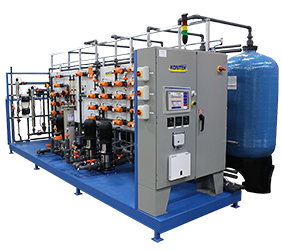
That’s where a company like Burlington-Ont. based, Kontek comes in. For over 40 years this Canadian manufacturer has specialized in providing unique technology solutions to facilitate effluent compliance, waste minimization, metals recovery, closed-loop water recycling, and zero liquid discharge (ZLD) and minimal liquid discharge (MLD).
For the metal finishing and many other industries, Kontek’s specialty products include the ability to provide in-house design and manufacturing with wastewater recovery and MLD or ZLD.
Most MLD or ZLD systems always include technologies to recover water but that produces a concentrated waste stream.
The higher the wastewater recovery rate, the more concentrated the residual liquid waste product becomes. At some point, a waste volume minimization unit operation must take place on the residual liquid waste product, to reduce a customers waste volume being hauled for offsite treatment and disposal.
Traditionally, Kontek would use atmospheric evaporators to boil and evaporate down the volume of the residual liquid waste product, however, all of the water vapour would be discharge to the atmosphere. In one case, the atmospheric evaporator was fitted with a condensing coil to allow for condensation of the water vapour to be turned in to a fairly good quality distillate.
However, these condensing coils required a high flow of externally supplied chilled water, driving up the overall cost per unit volume of recovered distillate.
Whether it’s fine tuning or increasing its research and development (R&D) efforts to develop solutions based on their customers’ needs, the Kontek team is always on the lookout for new solutions to add to their technology lineup. In fact, it has recently become a sales partner with H20, a German-based company that delivered a technical presentation at the Aluminum Anodizing Council’s annual conference, last fall in Kansas City, Mo.
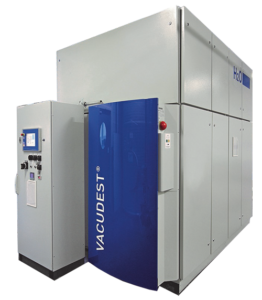
“Our main interest in H20’s technology is that it can produce a distillate that can be reused,” says David Chan, vice-president of Kontek. “That vapour could be condensed and collected as a condensate or distillate. And that’s what H20’s VACUDEST does. The H2O equipment appears to be very well engineered, with ruggedness and durability in mind, is operable with very minimal labour requirements, and manufactured to be easily serviceable. These are the hallmarks of a Kontek designed system, so we wanted to ensure we were aligning with a similar mentality supplier. Their abundance of case studies and empirical operational data provides confidence in including the VACUDEST into our wastewater recovery systems.”
The H2O system uses the relatively cooler residual liquid waste product that is fed into the VACUDEST to cool down the water vapour, instead of an external chilled water supply. This practice also pre-heats the residual liquid waste product so that an efficient evaporation/condensing cycle can be maintained.
Kontek’s attraction to the H2O unit is that it also has add on modules such as Clearcat for oil-free distillate and Purecat for Chemical Oxygen Demand (COD) compliance. “In a case where you’re dealing with wastewater with emulsified oils, they claim to have the ability to separate out the oils from the distillate, which is pretty attractive,” says Chan.
“And any time you’re dealing with oils or greases, there is likely a COD or a Biological Oxygen Demand (BOD) issue and their Purecat module reduces that.”
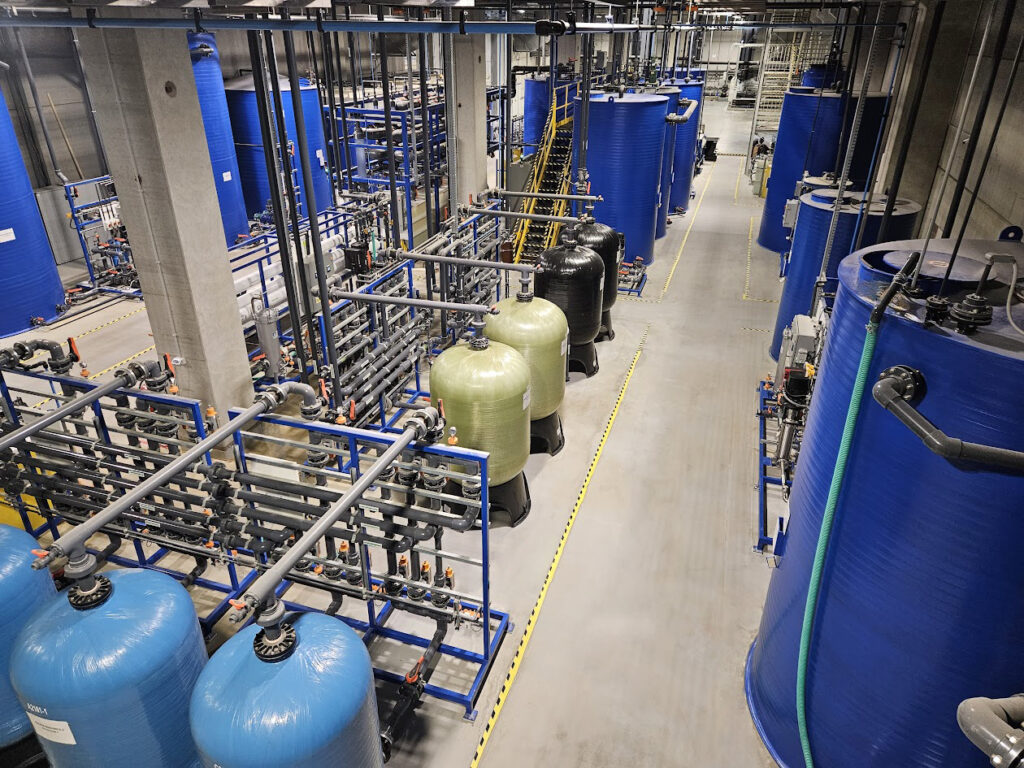
Since connecting with H20, Kontek has received requests for quotes (RFQs) on the H2O equipment, and has also integrated H2O VACUDEST units into many wastewater recovery systems’ design. We are also assisting them with projects in the US and Canada as well, from the supply on ancillary components, to installation and commissioning of their systems.
There are also new elements that are starting to appear on discharge permits—such as boron, selenium and molybdenum—due to toxicity levels that can affect marine and human life.
“We are working with a US company that has a plating process that contains nickel, molybdenum and cobalt. Ultimately, they’re doing nickel plating but through a very unconventional nickel bath. It’s not your typical nickel sulphate, nickel chloride or nickel sulfamate bath,” says Chan.
“Fortunately the company was running a prototype line so there was wastewater being produced to experiment with and we jointly developed a treatment protocol. We are still using the conventional phys-chem precipitation style of system with a pH adjustment and chemical additives and inclined plate clarifiers to separate the solids from the wastewater.” Chan continues, “But because of the unique nature of this type of wastewater we had to do a two-stage treatment, with each stage targeting the removal of the three metals.”
Additionally, Kontek is also considering ion exchange resins for use in removing either boron, selenium or cobalt, as these metals and their related metal complexes are challenging to remove or separate from wastewater via precipitation. Even with IX technology, there is a requirement to eventually evaporate the IX regenerant wastewater since this is where the removed metals will be concentrated.
But again, for Kontek it’s about finding the right technology or a mix of technologies to meet the unique needs of customers as it’s all about what’s in the solution to begin with and it’s facility specific.
“Our systems have anywhere from four to eight different technologies. And once you integrate them all together, then that becomes the system,” says Chan.
“With our sister company Moonstone, we are using different bentonite clay based additives to encapsulate the contaminants, which can then be filtered to remove said contaminants from the wastewater. Traditionally these units had a niche market in terms of oily wastewaters, spent coolant with emulsified oils or fluorescent penetrant indicator (FPI) rinse waters. A Moonstone unit, when compared to a Kontek system with a comparable flow rate, requires a lot less physical space, and is also much more cost effective.
Chan says that they recently tested water samples from a local anodizing shop and did treatment studies on all their individual process solutions and their rinse water. And in all cases, the Moonstone unit performed very well.
“We are yet to go to the next step of doing an analysis on the treated water partly because with anodizing rinse water at this location it would be aluminum. And with aluminum having a high discharge limit (typically 30-50 ppm), I’m 100 per cent sure that our treated rinse water sample is well below the limit,” says Chan. “We’re always looking at what other waste streams Moonstone can treat efficiently. Last year we sold many of these units to a company that manufactures anodizing or plating lines.
It’s a smaller, modular type of standalone treatment system with a lower capital cost, that in many cases will allow the customer to comply with their discharge regulations.”
Although plating and anodizing operations don’t particularly enjoy dealing with wastewater or may not consider it a priority until a fine is in place or there’s increased regulatory pressures, there are a variety of solutions that can help drive down the capital cost of such an investment.
It all comes down to risk mitigation. And while there are those striving for ZLD, Kontek has noticed more companies being more realistic with their waste minimization targets, and opting for MLD instead.
H20’s VACUDEST is a vacuum distillation technology that offers a physical evaporation process that separates surfactants, heavy metals, acids and alkalis from wastewater with a focus on the reuse of recovered water. The company says that direct vapour compression evaporators have been developed to reduce energy consumption during the evaporation process (the separation of water and contaminants through a difference in boiling point). An under-pressure of about 600 mbars is created using a roots compressor, working contact free in the evaporator. Due to the low pressure, water evaporates at temperatures around 86°C. The steam created by the evaporation is compressed to atmospheric pressure by the vacuum pump. Since the relation of temperature to pressure is constant (under ideal circumstances) the temperature of the steam will rise when the pressure increases. The hot steam will then be fed to a heat exchanger. The steam, which is just above 100°C, will condensate in the heat exchanger. The condensation energy is used to evaporate the wastewater being fed into the system; therefore no external heating systems are required. The condensation energy of the steam is sufficient to heat and evaporate the wastewater. The only energy consumer in the evaporator is the vacuum pump, using about 45 – 60 Wh/l. This energy consumption is by five times lower compared to heat pump systems.
“Due to the energy recycling, the required energy is about 45-75 kWh/m³, depending on the size of the equipment due to economy of scales,” says Marius Straub, project engineer for H20. “Compared to atmospheric evaporation system, which has an energy consumption of ~750 kWh/m³, the VACUDEST saves up to 95 per cent of the energy.”
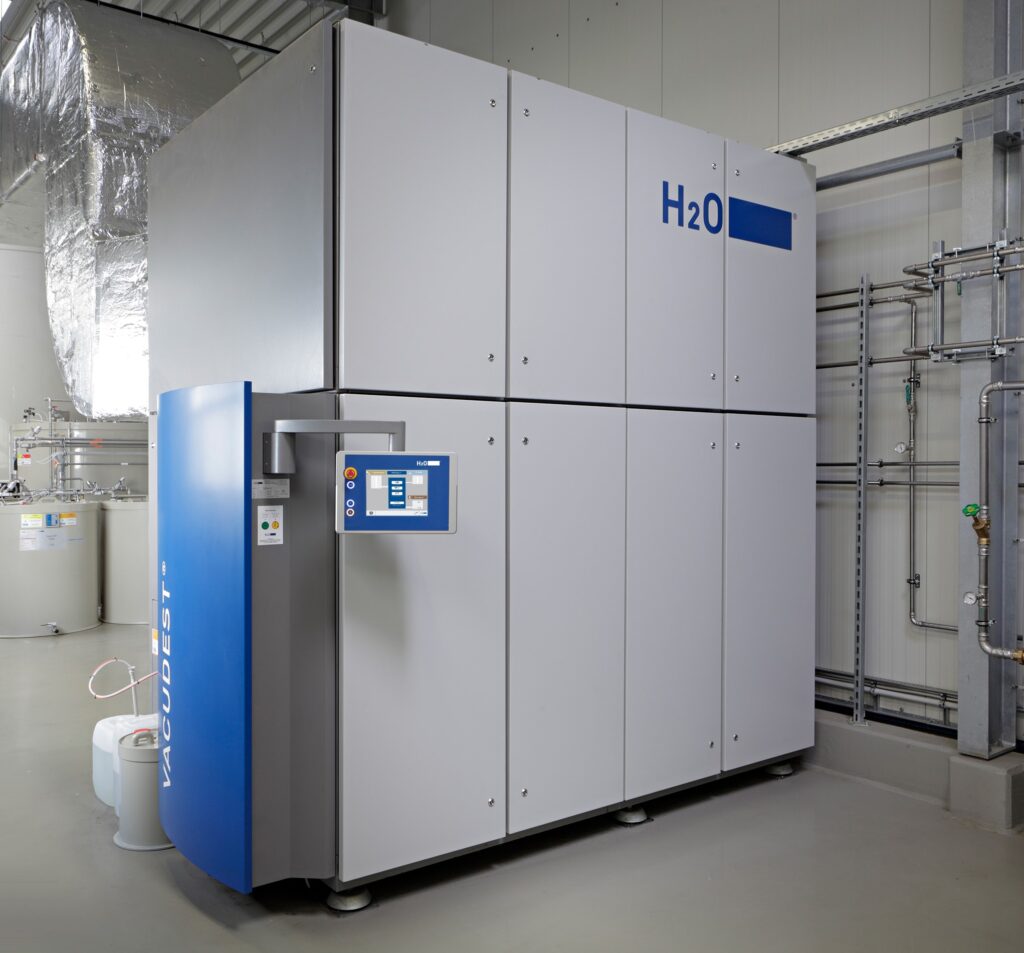
For plating and anodizing operations, Straub says that the key benefits include:
• Low running costs: about 10-15 USD/m³ including energy, labour, spare parts, and consumables.
• Recycling: In the majority of the applications the distillate quality is good enough to reuse the distillate directly or after polishing (e.g. IEX unit) in the process again.
• Easy handling: The unit is ready for industry 4.0 and its fully automatic operation offers a very low allocation of human resources (two-four h/week).